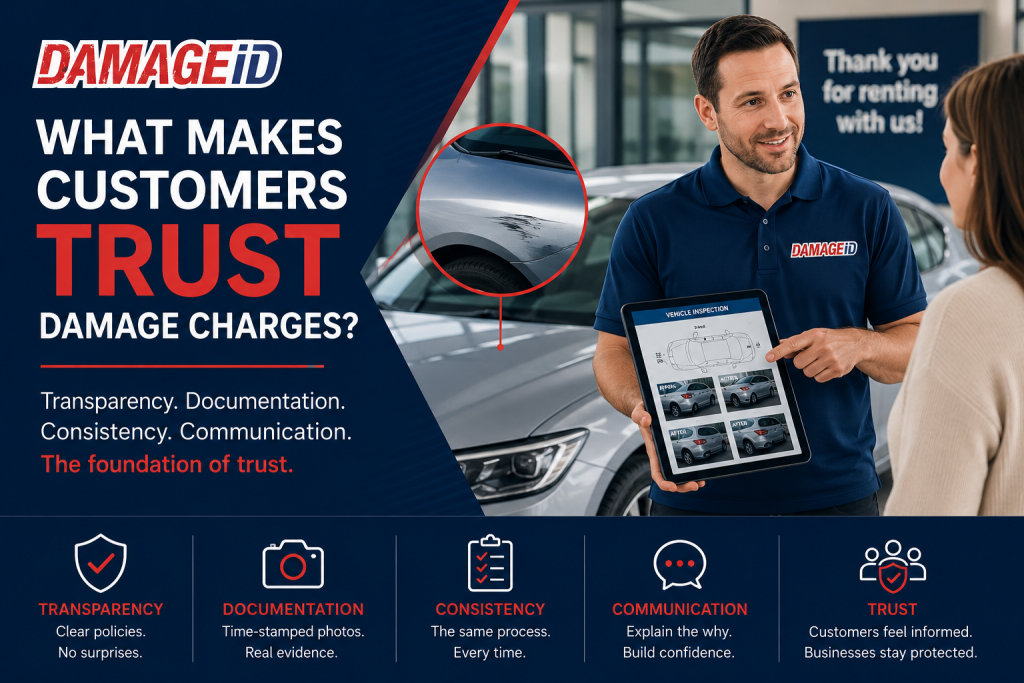
When a customer returns a rental vehicle, a delivery van, or a shared-use fleet vehicle, they expect the inspection process to be fair.
Most customers understand that if they cause damage, they may be responsible for paying for it. What they do not expect is to feel surprised, confused, or unsure about how that decision was made.
That difference is where trust is either built or lost.
At DAMAGE iD, we’ve had conversations with rental operators, fleet managers, and Amazon DSP owners across the country. While every operation is different, one theme comes up again and again:
Customers rarely become frustrated simply because damage was found.
They become frustrated when they don’t understand how the decision was made.
Trust Starts Before the Inspection
Many businesses assume trust begins when damage is discovered.
In reality, it starts much earlier.
Customers want to know:
- What happens during the inspection?
- What kinds of damage are billable?
- How is damage documented?
- Can they review the inspection themselves?
- What happens if they disagree?
When those questions are answered before the vehicle ever leaves the lot, customers are far less likely to feel caught off guard later.
Clear expectations create confidence.
Transparency Matters More Than Technology
During the International Car Rental Show, DAMAGE iD Business Development Manager Jeremy Martin shared an important observation.
If customers feel like they’re being “nickel and dimed,” the problem often isn’t the technology.
It’s the process.
Businesses should clearly communicate:
- Damage billing thresholds
- Customer responsibilities
- Inspection procedures
- Dispute timelines
- Documentation methods
When those policies are transparent, technology becomes something that supports trust instead of replacing it.
Customers Want Evidence
Imagine you’re returning a rental vehicle.
An employee tells you there’s a new scratch on the passenger door.
Which response builds more confidence?
Option A
“We noticed some damage.”
Or…
Option B
“We completed a check-out inspection before your rental and another when you returned. Here are the time-stamped photos showing the difference.”
The second conversation feels completely different.
Evidence removes uncertainty.
Good documentation protects both the business and the customer.
Consistency Creates Fairness
One of the biggest frustrations customers experience is inconsistency.
Maybe one employee documents every tiny scratch.
Another overlooks obvious dents.
A third takes only a few photos.
Now customers begin wondering:
“Why was my vehicle inspected differently?”
A standardized inspection process solves this problem.
Every vehicle.
Every customer.
Every time.
Consistency makes inspections feel fair.
Speed Builds Confidence
Long delays often make customers anxious.
Imagine returning a vehicle at 9:00 AM.
You hear nothing all day.
Then at 6:00 PM you receive an unexpected damage claim.
Naturally, questions arise.
Did the damage happen after you left?
Who accessed the vehicle?
Was it inspected immediately?
Prompt inspections with immediate documentation reduce uncertainty and improve confidence in the process.
Digital Documentation Makes Conversations Easier
Paper forms, scattered photos, and handwritten notes often make damage discussions more difficult.
Digital inspections provide:
- Time-stamped photos
- Organized inspection history
- Vehicle condition reports
- Centralized records
- Easier historical comparisons
Instead of relying on memory, businesses can rely on documentation.
That changes the entire conversation.
Trust Also Protects Employees
Good documentation doesn’t only benefit customers.
It also protects employees.
Without consistent inspections, employees may be blamed for damage they didn’t cause or struggle to explain incomplete records.
Structured inspection workflows help ensure everyone follows the same process.
That creates confidence across the entire organization.
AI Is a Tool, Not the Decision Maker
Artificial intelligence is becoming more common in vehicle inspections.
Some customers worry that AI is making decisions on its own.
The reality is much different.
AI is designed to assist by:
- Identifying possible damage
- Improving inspection consistency
- Supporting documentation
- Helping organize inspection history
People still make decisions.
AI simply provides better information.
Why Trust Matters Financially
Trust affects much more than customer satisfaction.
Businesses with transparent inspection processes often experience:
- Faster damage resolution
- Fewer disputes
- Better customer retention
- Stronger online reviews
- More efficient operations
Customers are much more likely to accept damage findings when they believe the process is fair.
What DAMAGE iD Believes
At DAMAGE iD, we believe technology should make inspections more transparent, not more complicated.
Guided inspections, centralized documentation, AI-supported workflows, and clear records all work together to help businesses create inspection processes customers can trust.
Technology alone cannot build trust.
People and processes do that.
Technology simply helps support them.
Final Thoughts
Damage charges will probably never be enjoyable conversations.
But they don’t have to become confrontations.
When inspections are consistent, documentation is clear, and expectations are communicated from the beginning, customers are much more likely to view the process as fair.
Trust isn’t created when damage is found.
It’s created by everything that happens before that moment.