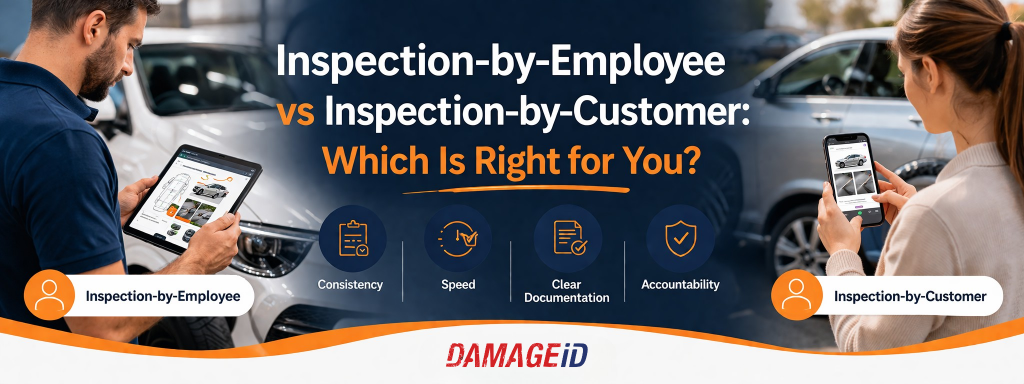
Vehicle inspections are a critical part of fleet and rental operations. They protect your assets, reduce disputes, and create accountability. However, one important decision many businesses face is who should complete those inspections.
Should inspections be handled by employees, or should customers complete them themselves?
The answer depends on your operation, your workflow, and your goals. Each approach offers distinct advantages, and in many cases, the best solution may be a combination of both.
Inspection by Employee
Employee led inspections are the traditional approach. A team member completes a walkaround of the vehicle, documenting its condition before and after use.
Benefits of Employee Inspections
One of the biggest advantages is control.
Employees are trained to follow a specific process, ensuring that inspections are completed consistently. They understand what to look for and how to document damage properly.
This approach can also provide a higher level of confidence in the inspection itself. Since the process is handled internally, businesses can ensure that standards are being met.
Employee inspections are especially valuable in:
• High touch rental environments
• Locations where staff are always present
• Operations that require detailed oversight
Challenges of Employee Inspections
While effective, employee inspections can be time consuming.
In high volume environments, inspections may be rushed or skipped altogether. Even well trained employees can miss minor damage, especially when vehicles are moving quickly.
There is also a labor cost to consider. Time spent on inspections is time that could be used for other operational tasks.
Inspection by Customer
Customer led inspections are becoming more common as technology evolves. In this model, the customer completes the inspection themselves using a guided process, often through a link on their mobile device.
Benefits of Customer Inspections
The biggest advantage is efficiency.
Customer inspections reduce the need for staff involvement, allowing operations to move faster. This is especially useful for after hours pickups and returns, remote locations, or high volume environments.
They also introduce a level of transparency. When customers document the condition themselves, there is less room for disagreement later.
Customer inspections are ideal for:
• After hours returns
• Contactless rental workflows
• Remote or unattended locations
• High volume operations
Challenges of Customer Inspections
The main concern with customer led inspections is consistency.
Customers may not always follow instructions carefully or capture images at the correct angles. Without guidance, important details could be missed.
There is also the potential for intentional or unintentional omissions. Without a structured system, documentation may not be reliable.
This is why guided inspection tools are critical. A structured workflow ensures that customers capture the required images and complete the process correctly.
The Best Approach: A Hybrid Model
For many businesses, the most effective solution is not choosing one over the other. It is combining both.
A hybrid approach allows you to use employee inspections when control is needed and customer inspections when flexibility is required.
For example:
• Employees handle inspections during business hours
• Customers complete inspections for after hours returns
• Both parties contribute to a complete inspection record
This creates a more flexible and scalable workflow without sacrificing accountability.
How Technology Bridges the Gap
Modern inspection platforms make it possible to standardize both employee and customer inspections.
Guided workflows ensure that every inspection follows the same process, regardless of who completes it. Features like required photos, time stamped documentation, and side-by-side comparisons help maintain consistency and accuracy.
AI powered tools can further enhance the process by identifying potential damage and supporting both employees and customers in real time.
This combination of structure and flexibility allows businesses to choose the approach that works best for each situation.
Choosing What Is Right for Your Operation
There is no one size fits all answer.
If your operation prioritizes control and consistency, employee inspections may be the best fit. If speed and flexibility are more important, customer inspections may offer greater value.
Most operations benefit from a mix of both.
The key is to ensure that whichever approach you use, the process is consistent, documented, and easy to follow.
Final Thoughts
Vehicle inspections are not just a routine task. They are a critical part of protecting your business.
Whether completed by employees or customers, the goal remains the same. Capture clear, accurate documentation that reduces disputes and supports accountability.
The right approach is the one that fits seamlessly into your workflow while delivering reliable results every time. DamageiD offers employee and customer inspection options.