
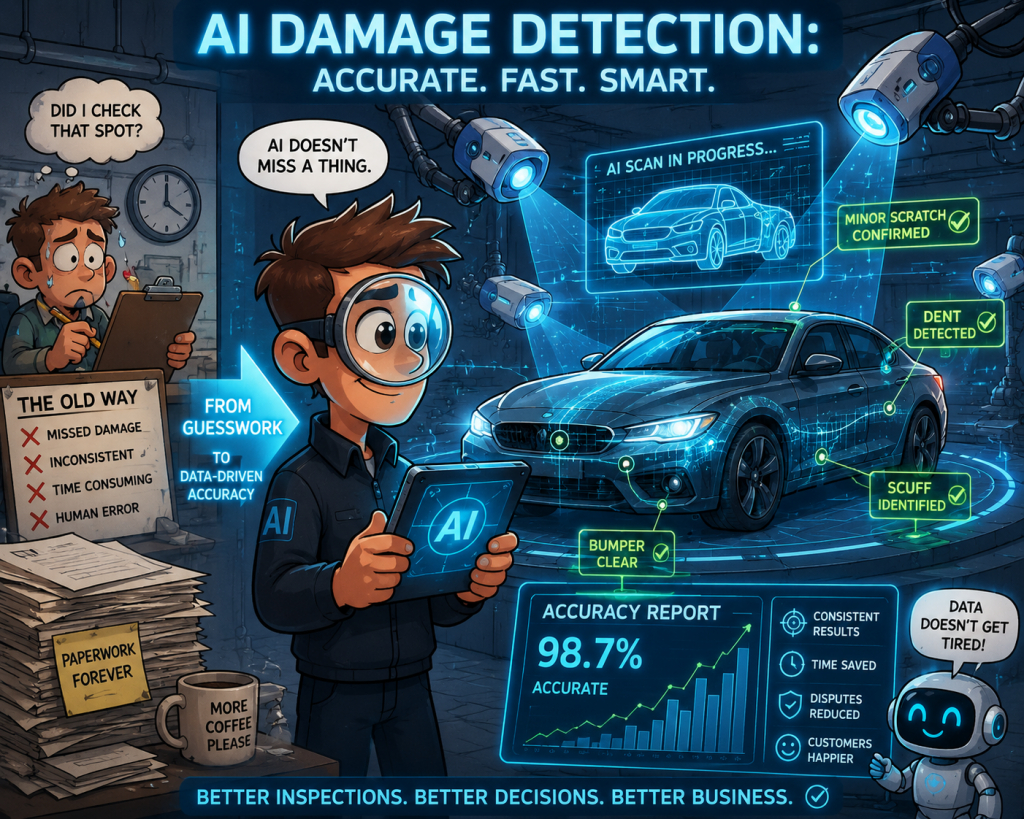
Artificial intelligence has become one of the biggest talking points in fleet management, vehicle inspections, and rental operations. From automation to predictive analytics, AI is rapidly changing how businesses manage vehicles and reduce operational costs.
But one question continues to come up:
Is AI damage detection actually accurate?
The short answer is yes, but understanding why requires looking beyond the buzzwords and into how AI-assisted inspections actually work in real-world operations.
Why Traditional Inspections Often Fall Short
Vehicle inspections have historically depended heavily on human consistency. That creates several common challenges:
- Minor damage gets overlooked
- Inspection quality varies between employees
- Documentation may be incomplete
- Lighting and angles affect visibility
- Damage disputes become difficult to resolve
Even highly trained employees can miss scratches, dents, or scuffs during busy operations. When fleets process dozens or hundreds of vehicles per day, consistency becomes increasingly difficult.
This is where AI-assisted inspections are beginning to make a major difference.
What AI Damage Detection Actually Does
AI damage detection is not simply “looking at a picture.” Modern systems analyze vehicle photos to identify irregularities, compare inspection history, and flag potential areas of concern.
Instead of relying entirely on manual review, AI helps:
- Detect visible exterior damage
- Highlight changes between inspections
- Improve inspection consistency
- Speed up documentation review
- Reduce missed damage incidents
At DAMAGE iD, AI capabilities continue evolving as the technology improves, helping fleets streamline inspections without adding complexity to the process.
Accuracy Improves with Consistency
One of the biggest advantages of AI is not perfection. It is consistency.
Human inspections naturally vary based on:
- Fatigue
- Time pressure
- Experience level
- Environmental conditions
- Attention to detail
AI systems apply the same analysis standards every time. That consistency helps fleets create more reliable documentation across locations, drivers, and employees.
In many cases, AI works best as a support tool rather than a replacement for human oversight.
The Data Fleets Care About Most
For fleet operators and rental companies, accuracy is important, but outcomes matter even more.
Businesses want to know:
- Are fewer damages being missed?
- Are disputes decreasing?
- Is documentation improving?
- Are inspections becoming faster?
- Is revenue recovery increasing?
For many companies, the answer is yes.
AI-assisted inspections help create clearer visual records and standardized processes that reduce uncertainty when questions arise about vehicle condition.
AI Is Constantly Improving
One major advantage of AI technology is that it does not remain static.
As more inspections are processed and more data becomes available, systems continue improving their ability to recognize patterns and identify potential damage more effectively.
This ongoing development is especially important in industries like:
- Car rentals
- Fleet management
- Amazon DSP operations
- Logistics and delivery
- Boat and equipment rentals
As operations scale, manual-only inspections become harder to manage consistently.
AI Is Not About Replacing People
One common misconception is that AI exists to replace employees.
In reality, the goal is usually to help teams work more efficiently and reduce preventable issues.
AI-assisted inspections allow employees to:
- Spend less time reviewing every image manually
- Focus on higher-priority issues
- Create more standardized inspections
- Improve accountability and documentation
The result is often a faster and more reliable inspection process overall.
The Future of Vehicle Inspections
AI damage detection is still evolving, but the direction is clear.
Fleet operators increasingly want:
- Faster inspections
- Better documentation
- Reduced disputes
- Improved consistency
- More automation
As AI capabilities continue advancing, businesses that adopt digital inspection processes early may gain significant operational advantages over companies still relying entirely on paper forms and manual workflows.
At the end of the day, AI damage detection is not about replacing human judgment. It is about improving visibility, consistency, and efficiency in a process that directly impacts revenue and accountability.