
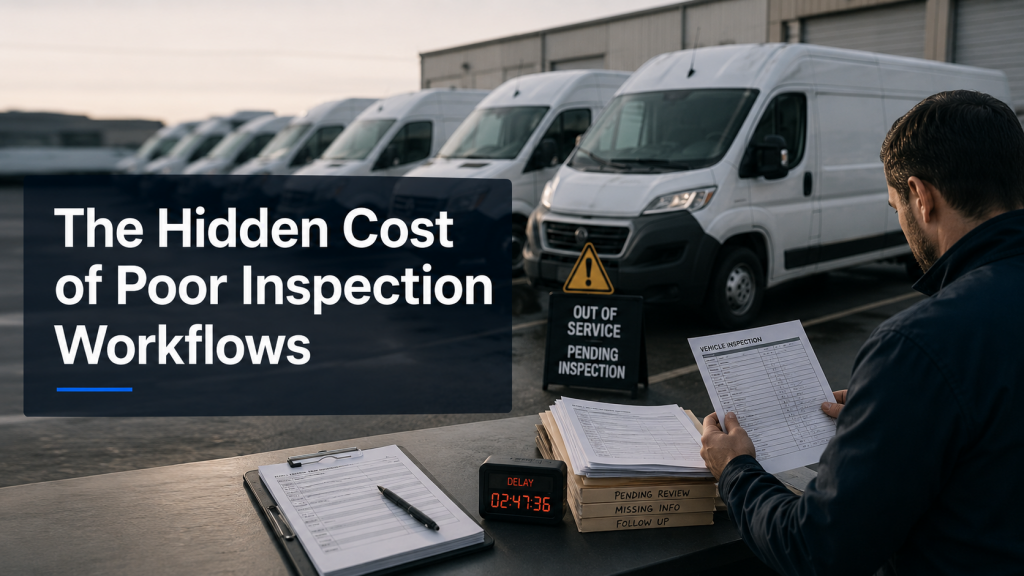
Most fleet operators carefully track fuel costs, maintenance expenses, insurance premiums, and vehicle utilization.
But one of the most expensive operational problems often goes unnoticed because it does not appear on a monthly report as a single line item.
Poor inspection workflows.
Unlike a repair bill or insurance invoice, inspection inefficiencies show up as dozens of small problems spread throughout the operation. A missed photo. An incomplete report. A delayed repair approval. A vehicle sitting idle while someone tries to determine when damage occurred.
Individually, these issues seem minor.
Collectively, they can cost thousands, and sometimes hundreds of thousands, of dollars each year.
The Cost of Damage That Cannot Be Explained
One of the most common problems across fleets, rental companies, and delivery operations is damage that gets discovered too late.
Imagine a logistics company operating 75 vehicles.
A driver completes a route and parks a van at the end of the day. The next morning, another driver takes the same vehicle out. Two days later, a manager notices a dent on the passenger-side door.
Now the investigation begins.
Who caused it?
When did it happen?
Was it reported?
Was it already there?
Without clear documentation, nobody knows for sure.
The repair still needs to happen, but accountability becomes difficult. In many cases, the business absorbs the cost because there is no reliable way to determine responsibility.
Amazon DSPs Feel the Impact Daily
Amazon DSPs operate in one of the most demanding vehicle environments.
Vehicles leave early, return late, and are often back on the road again within hours.
During peak season, many DSPs are processing dozens of vans every day.
A common workflow might look something like this:
A driver finishes a ten-hour route and returns to the station.
The vehicle inspection is rushed because everyone wants to go home.
The driver snaps a few photos, skips a few others, and submits the report.
The next morning another driver notices a damaged mirror.
Now management has a problem.
The previous inspection included only two exterior photos, neither showing the damaged area.
There is no way to confirm whether the damage happened during the previous route, overnight in the lot, or during the current shift.
The result is lost time, frustrated employees, and a repair bill that still has to be paid.
Rental Companies Lose Revenue Through Delays
For rental operations, inspection problems often show up as slower vehicle turnaround.
Consider a busy rental location during a holiday weekend.
Vehicles are being returned continuously throughout the day.
An employee notices a scratch on a bumper but cannot determine whether it is new.
The previous inspection exists, but the photos were taken in poor lighting and do not clearly show the area in question.
A manager has to review records.
Additional employees become involved.
Phone calls are made.
Time is spent comparing photos.
Meanwhile, that vehicle remains unavailable for rent.
The cost is not just the scratch.
The cost is also the lost rental opportunity while the situation is being reviewed.
Transportation Fleets Spend More Time Investigating Than Managing
Many transportation companies still rely on a combination of:
- Paper inspection forms
- Text messages
- Shared drives
- Email chains
- Manual photo storage
The inspection itself may take only a few minutes.
Finding the inspection later is often the real challenge.
Managers frequently spend time:
- Searching for photos
- Reviewing old reports
- Comparing timestamps
- Contacting drivers
- Verifying vehicle history
Instead of focusing on operations, they become investigators.
The labor cost associated with these activities is rarely measured, but it exists every day.
Small Delays Become Large Expenses
Consider a fleet of 100 vehicles.
If inspection inefficiencies add just five extra minutes per vehicle each day, that equals more than eight hours of lost productivity daily.
Over a year, those small delays add up to hundreds of hours.
The cost is not limited to labor.
Those delays often create:
- Slower vehicle turnaround
- Delayed repairs
- Increased downtime
- Missed damage recovery opportunities
- Lower vehicle utilization
Small inefficiencies have a way of multiplying across an operation.
The Human Cost Is Often Overlooked
Poor inspection workflows do not only affect vehicles.
They affect people.
Drivers become frustrated when they are blamed for damage they did not cause.
Managers become frustrated when records are incomplete.
Maintenance teams become frustrated when information is missing.
Customers become frustrated when disputes take longer than expected to resolve.
Over time, trust begins to erode.
Clear documentation helps eliminate uncertainty and creates a more accountable process for everyone involved.
What Better Inspection Workflows Look Like
High-performing fleets tend to share several common characteristics.
They focus on:
Standardization
Every vehicle follows the same inspection process.
Every employee follows the same workflow.
Consistency becomes the norm instead of the exception.
Photo Documentation
Required photos ensure important areas are captured every time.
This reduces gaps in documentation and improves accountability.
Centralized Records
Inspection history is stored in one location rather than scattered across devices, folders, and email chains.
Real-Time Access
Managers, maintenance teams, and operations staff can access records immediately when questions arise.
Faster Decision Making
When vehicle condition is clearly documented, teams can make repair, billing, and operational decisions more quickly.
Why More Companies Are Moving to Digital Inspections
Across logistics, rental, transportation, and delivery operations, businesses are increasingly moving toward digital inspection processes.
The reason is simple.
Better workflows create better outcomes.
Digital inspections help organizations:
- Improve consistency
- Reduce administrative work
- Increase accountability
- Improve vehicle visibility
- Speed up turnaround times
- Reduce disputes
AI-supported inspection tools add another layer of consistency by helping teams identify potential damage and maintain standardized documentation.
Final Thoughts
The hidden cost of poor inspection workflows is rarely one major expense.
It is hundreds of small inefficiencies happening every day.
A missed photo.
A delayed approval.
An unresolved dispute.
A vehicle sitting idle.
A manager searching through folders for documentation.
Individually, they seem insignificant.
Together, they can have a major impact on profitability, efficiency, and accountability.
That is why more fleets, rental companies, transportation providers, and Amazon DSPs are investing in better inspection processes.
Not because inspections are exciting.
Because operational efficiency matters.
See It in Action
DAMAGE iD helps fleets streamline inspections, improve documentation, reduce disputes, and create more efficient workflows with structured, AI-supported vehicle inspections.
Start your free trial today.