
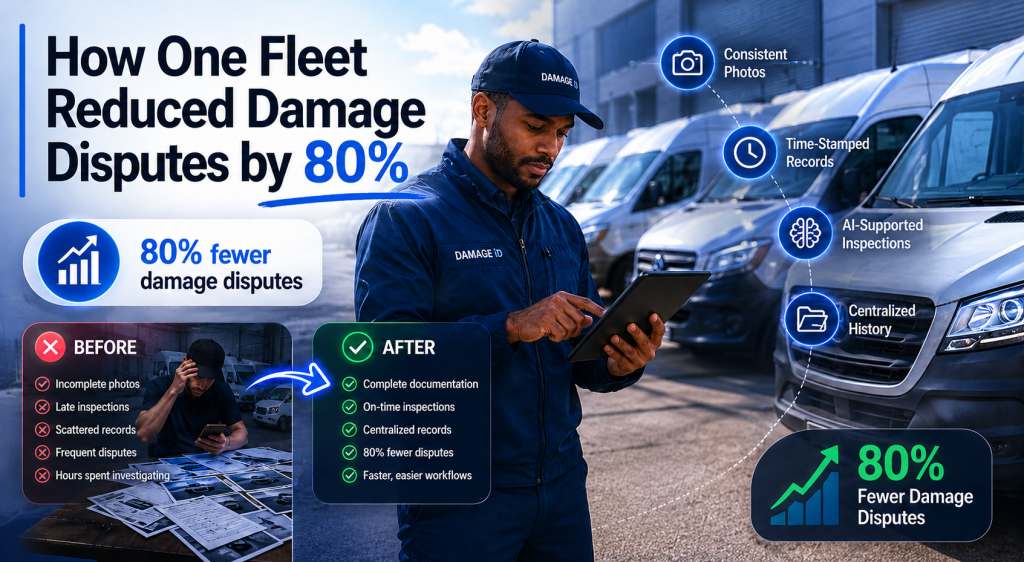
How One Fleet Reduced Damage Disputes by 80%
When the operations manager of a regional delivery fleet first spoke with the DAMAGE iD team, the frustration was obvious.
The company operated roughly 65 delivery vans across multiple daily routes with drivers rotating vehicles constantly throughout the week. Vehicles were being checked out early in the morning, returned late at night, reassigned mid-day, and sometimes used by multiple drivers within a 24-hour period.
The fleet had a vehicle inspection process in place, but in reality, it was inconsistent, rushed, and creating major operational problems.
What Their Inspection Process Looked Like Before
Before switching to DAMAGE iD, the company relied on a very loose manual inspection process.
Drivers were expected to:
- Walk around the van before routes
- Take a few photos if they noticed damage
- Text photos to supervisors if something looked serious
- Fill out a basic paper or digital checklist when they remembered
There was no standardized photo process.
No required inspection angles.
No guided workflow.
No centralized inspection history.
Some drivers were thorough, but many inspections depended entirely on:
- How busy the shift was
- Weather conditions
- Lighting
- Whether the driver was in a rush
- Whether the employee even remembered to complete the inspection
Morning drivers often skipped inspections because they wanted to get routes started quickly.
Night drivers sometimes rushed through returns because they were exhausted after long delivery days.
One manager admitted:
“Some inspections were taking less than two minutes because people just wanted to clock out and go home.”
The Small Problems That Became Big Problems
At first glance, the issues seemed minor.
But those small gaps kept turning into expensive operational problems.
Examples included:
- A small scratch near a rear bumper corner that was never photographed during check-out
- Blurry nighttime photos where damage could barely be seen
- Drivers taking photos too close to the vehicle so there was no full context
- Employees forgetting to photograph one entire side of the van
- A cracked mirror going undocumented for three days because different shifts assumed someone else had already reported it
- Drivers forgetting inspections completely after difficult routes or peak delivery days
Because inspections were inconsistent, managers often had incomplete information when damage was discovered later.
The Real Documentation Problems
The biggest issue was not just missed damage.
It was unreliable records.
In many cases:
- Before photos existed, but no after photos were taken
- A driver would take photos at 6:00 AM, but the return inspection would not happen until 11:00 PM after multiple other employees had already accessed the vehicle
- Photos were saved on personal phones instead of company systems
- Supervisors received inspection pictures through text messages that later became impossible to locate
- One location stored photos in Google Drive while another used email threads
- Paper inspection sheets were sometimes left inside vehicles or lost completely
One specific incident became a turning point for leadership.
A van returned with a dent near the sliding door.
The morning driver insisted it was already there.
The previous night driver claimed the damage happened during the morning shift.
Managers attempted to review documentation, but:
- The previous inspection only included two blurry front-end photos
- The side panel where the dent existed was never photographed
- The timestamp on one photo was missing because it had been manually uploaded later
- The return inspection had not been completed until almost four hours after the van was parked
The company ended up absorbing the repair cost because nobody could confidently determine when the damage occurred.
Situations like this were happening constantly.
Managers Were Spending Hours Investigating Damage
Instead of managing operations, supervisors were becoming investigators.
Managers regularly spent hours:
- Searching through employee text messages
- Comparing timestamps manually
- Looking through camera rolls for missing photos
- Calling drivers to ask when they last used vehicles
- Trying to piece together incomplete timelines
Some disputes dragged on for days.
The process created frustration across the entire company.
Drivers Started Losing Trust in the System
Good drivers became frustrated because they felt vulnerable to being blamed for damage they did not cause.
Some employees started taking dozens of personal photos before every shift just to protect themselves.
Others stopped reporting minor damage entirely because they believed nothing would happen anyway.
The inspection process was no longer creating accountability.
It was creating distrust.
What Changed After Switching to DAMAGE iD
The fleet realized they did not just need more inspections.
They needed a process that forced consistency.
After implementing DAMAGE iD, every inspection followed the same structured workflow.
Drivers were guided through required photo angles and inspection steps directly inside the platform.
Instead of relying on memory or personal judgment, the system standardized the process automatically.
1. Guided Inspections Eliminated Guesswork
Drivers were now prompted to capture:
- Front corners
- Rear corners
- Side panels
- Wheels
- Mirrors
- Interior condition
This ensured every vehicle was documented the same way regardless of:
- Shift
- Driver
- Location
- Experience level
Managers immediately noticed the difference in photo quality and inspection consistency.
2. Records Became Centralized and Time-Stamped
Every inspection was now:
- Automatically time-stamped
- Stored in one centralized system
- Linked directly to the correct vehicle
- Accessible instantly by management
Managers no longer had to search phones, texts, or folders looking for evidence.
Everything existed in one organized inspection history.
3. AI-Supported Inspections Reduced Missed Damage
AI-supported workflows helped identify possible damage areas during inspections.
This helped reduce:
- Missed scratches
- Unreported dents
- Incomplete inspections
- Inconsistent documentation
The process no longer depended entirely on whether a driver was tired, rushed, or distracted.
The Results After Several Months
Within a few months:
- Damage disputes dropped by roughly 80%
- Managers spent far less time investigating incidents
- Drivers trusted the inspection process more
- Repairs were approved faster
- Vehicle turnaround became smoother
- Documentation became significantly more reliable
Most importantly, leadership finally had confidence in the records being created across the fleet.
Final Thoughts
For this fleet, the biggest operational problem was not vehicle damage itself.
It was inconsistent inspections and unreliable documentation.
DAMAGE iD helped standardize the process, improve accountability, and create records the company could actually trust.
The result was fewer disputes, less wasted time, and a much more efficient operation overall.
See It in Action
DAMAGE iD helps fleets create more consistent inspections, improve accountability, and reduce damage disputes with structured digital workflows and AI-supported inspection tools.
Start your free trial here:
https://www.damageid.com/free-trial/