
Vehicle inspections are becoming increasingly automated.
Across transportation and fleet operations, artificial intelligence is moving beyond dashboards and reports and into the physical inspection process. Automation is increasingly being used to improve monitoring, efficiency, and inspection-related tasks.
For businesses managing dozens, hundreds, or thousands of vehicles, that shift makes sense. Manual inspections take time, employees can miss things, and busy operations do not always leave room for a detailed inspection after every vehicle movement.
But there is an important distinction fleet operators should keep in mind:
Finding damage is only part of the inspection process. Documenting it clearly is what makes the information useful.
Automation Is Changing What an Inspection Can Look Like
Traditional inspections depend heavily on the person standing next to the vehicle.
An employee walks around the vehicle, looks for damage, records what they see, and hopefully takes photographs. The process can work well, but consistency becomes harder as fleet size and utilization increase.
One employee may photograph every panel. Another may take three pictures. One may notice a small bumper scrape. Another may overlook it because the vehicle is needed for the next route.
AI can help address part of that problem by analyzing vehicle images and identifying potential damage.
The technology is becoming increasingly visible across the automotive and transportation industries. Recent investment in AI-powered vehicle inspection technology is another indication that automated damage detection is becoming a more important part of the industry.
The larger trend is clear. Vehicle inspection is becoming a more data-driven process rather than simply a visual task.
But that creates a new question for fleet operators:
What happens after the AI identifies something?
Detection Without Documentation Can Still Create Problems
Imagine a delivery van returns at the end of a busy day.
An inspection system identifies a new scratch on the passenger-side bumper.
That information is useful, but a fleet manager still needs to know:
- Was the damage actually new?
- Was the same area photographed before the vehicle left?
- Who had the vehicle previously?
- When was the damage first identified?
- What did the vehicle look like immediately before and after the assignment?
- Is the damage significant enough to require repair?
- Does the vehicle need to be removed from service?
Without a reliable inspection record, the answer to many of those questions can become difficult to establish.
This issue is not limited to commercial fleets.
Rental vehicle damage disputes are frequently discussed by consumers, particularly when a renter believes a vehicle was returned without damage but a charge is later issued. Individual online discussions are not evidence of an industry-wide trend, but they illustrate an important operational reality:
When there is a disagreement, documentation becomes the evidence.
The Goal Should Be Better Decisions, Not Just More AI
Fleet operators should not look at AI inspection technology simply as a way to replace employees.
The bigger opportunity is to give employees better information.
An effective inspection process can combine technology with human judgment.
For example, AI can help identify potential damage in vehicle images. A consistent digital inspection can establish when those images were captured. Before-and-after comparisons can help show whether a condition changed. A time-stamped record can provide additional context when questions arise later.
The employee or manager can then make the operational decision.
This distinction is important because AI is increasingly being introduced throughout fleet operations. The objective is not necessarily to remove people from the process.
It is to remove unnecessary uncertainty.
High-Utilization Fleets Have More to Gain
This becomes particularly important for businesses where vehicles are constantly moving.
Consider an Amazon DSP with vehicles being used for delivery routes every day.
A vehicle might be driven by different employees throughout the week. It may leave the station in the morning, return later, receive maintenance, and go back out again.
A rental company faces a similar challenge. A vehicle may move from one customer to another with very little downtime.
The more frequently a vehicle changes hands, the harder it becomes to determine when a small scratch, dent, scuff, or other condition appeared.
That is why consistent inspections are valuable even when the damage itself seems minor.
A digital record can create a chain of vehicle condition:
Before use → After use → Next assignment → Next inspection
Over time, those records can become more than individual inspection reports. They can help fleet managers identify recurring damage locations, understand vehicle history, investigate disputes, and make better maintenance decisions.
What Fleet Operators Should Look for in an Automated Inspection Process
As inspection technology becomes more sophisticated, fleet operators should look beyond the question of whether a system uses AI.
Ask whether the entire inspection workflow creates useful documentation.
A practical system should make it easy to:
- Capture consistent images or video.
- Compare vehicle condition before and after use.
- Identify potential damage.
- Create time-stamped records.
- Associate inspections with the appropriate vehicle and user.
- Access historical inspection information.
- Share documentation when a dispute occurs.
- Use the resulting information to improve fleet operations.
That is where technology such as DAMAGE iD can play a practical role.
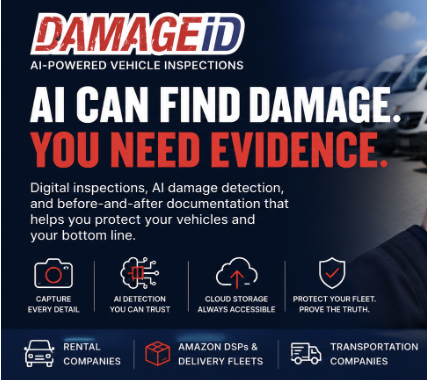
DAMAGE iD combines digital vehicle inspections, AI damage detection, before-and-after image and video comparison, time-stamped records, customizable inspection templates, and cloud-based documentation to help businesses create a consistent record of vehicle condition.
The value is not simply that technology can identify a scratch.
The value is having a documented picture of what happened before and after a vehicle was used.
The Next Step in Fleet Inspections Is Better Evidence
AI is becoming a bigger part of vehicle and fleet operations, and that trend is unlikely to reverse.
But automation alone does not eliminate inspection problems.
A system that identifies damage without creating reliable documentation can still leave fleet managers trying to answer the same questions they faced with manual inspections.
The better approach is to use technology to make the entire process more consistent.
For rental companies, DSPs, delivery fleets, transportation companies, and other high-utilization operations, that means creating a dependable record of vehicle condition every time a vehicle changes hands.
DAMAGE iD is designed to help businesses do exactly that, while giving managers a clearer view of vehicle condition and damage history.
How confident are you that your current inspection records could prove exactly when a piece of vehicle damage occurred?