
For years, vehicle inspections have depended largely on people walking around vehicles, taking photographs, checking boxes, and deciding whether something looks different from the last inspection.
That process is not disappearing. But it is changing.
Recent developments in the vehicle inspection industry show how quickly artificial intelligence and computer vision are moving into real-world fleet, rental, dealership, logistics, and transportation operations. The global AI vehicle inspection system market was valued at approximately $1.94 billion in 2025 and is projected to reach more than $10.29 billion by 2035, according to Acumen Research and Consulting. The report points to automation, faster inspections, standardized condition assessments, and damage detection as major drivers of that growth. (TimesTech)
For businesses managing dozens, hundreds, or thousands of vehicles, the bigger question is not whether AI is coming.
It is how to use it without losing the human judgment and business processes that make an inspection useful.
The Industry Is Already Putting AI to Work
AI vehicle inspection is no longer limited to experimental technology.
Amazon, for example, has already introduced automated vehicle inspection technology using computer vision to help fleet managers identify vehicle conditions that previously depended heavily on manual inspections. (Automotive Fleet)
The technology is also expanding beyond passenger vehicles. Recent industry developments have included AI inspection systems being adapted for commercial fleets, trucks, buses, dealerships, rental operations, and other vehicle environments. (THE SHOP)
That expansion matters because commercial vehicles create a particularly difficult inspection environment.
A delivery van may leave a facility before sunrise, complete a full route, return late in the evening, and be assigned to another driver the following morning. A rental vehicle may be inspected between customers while employees are trying to keep vehicles moving. A transportation fleet may have vehicles changing drivers and locations throughout the day.
In each situation, the inspection has to be completed consistently despite time pressure.
That is where AI can become useful.
The Real Problem Is Consistency
The biggest benefit of AI-assisted inspection is not necessarily that it can “see” something a person cannot.
It is that technology can help create a more repeatable process.
Consider two employees inspecting the same vehicle.
One employee carefully walks around the entire vehicle and photographs every required area. Another employee is running behind and takes several quick pictures before moving the vehicle.
Both employees may believe they completed the inspection.
The resulting documentation, however, can be very different.
Lighting, camera angle, employee experience, fatigue, weather, and time pressure can all affect what gets documented.
For a fleet manager, that inconsistency creates a problem later.
If a scratch is discovered two days after a vehicle changes hands, the question is no longer simply whether the scratch exists. The question becomes whether there is enough evidence to determine when it appeared.
Digital inspections can establish a structured record. AI can add another layer by helping identify potential damage and changes between inspections.
The objective is not to eliminate people from the process.
It is to give people better information.
Technology Does Not Replace a Good Process
There is an important lesson for fleet and rental operators considering AI.
Buying inspection technology does not automatically create a good inspection process.
The industry has already seen examples demonstrating why implementation matters. In 2025, Hertz faced significant customer-experience criticism surrounding an AI-powered vehicle scanning system. The episode highlighted an important reality: technology can improve efficiency, but businesses still need clear processes for communicating findings, handling questions, and resolving disputes. (CX Dive)
That lesson is particularly relevant for rental companies.
If a customer receives a damage charge, the customer needs more than a technology-generated result. They need to understand what was identified, how the vehicle was documented, and what the company’s policies say about responsibility.
The technology should support that conversation, not replace it.
For fleet operators and Amazon DSPs, the same principle applies internally.
Drivers need to know what they are expected to document. Managers need access to the records. Maintenance teams need usable information. Operations teams need a process that does not create unnecessary administrative work.
AI is most valuable when it fits into that larger workflow.
What Fleet Operators Should Look For
Businesses evaluating AI-assisted inspection technology should look beyond the words “AI-powered” on a product page.
The more important questions are practical.
Does the system make inspections easier for employees?
If drivers need extensive training or employees have to work through a complicated process, adoption can become a problem.
Does it create consistent documentation?
Required photos, guided inspection steps, time-stamped records, and organized vehicle histories can be just as important as the AI itself.
Can managers compare vehicle condition over time?
A single photograph tells only part of the story. Before-and-after documentation provides much greater context.
Can the information be accessed when a dispute occurs?
If a manager has to search through text messages, email, personal phones, and shared folders, the technology has not solved the underlying documentation problem.
Does it work with the way the business already operates?
API integration and compatibility with existing fleet or rental systems can make digital inspection technology much more useful because inspection information does not have to exist in isolation.
Where DAMAGE iD Fits
This is the approach DAMAGE iD takes with digital vehicle inspections.
The goal is not to give fleet operators another complicated system to manage. It is to make vehicle documentation easier to complete and easier to understand.
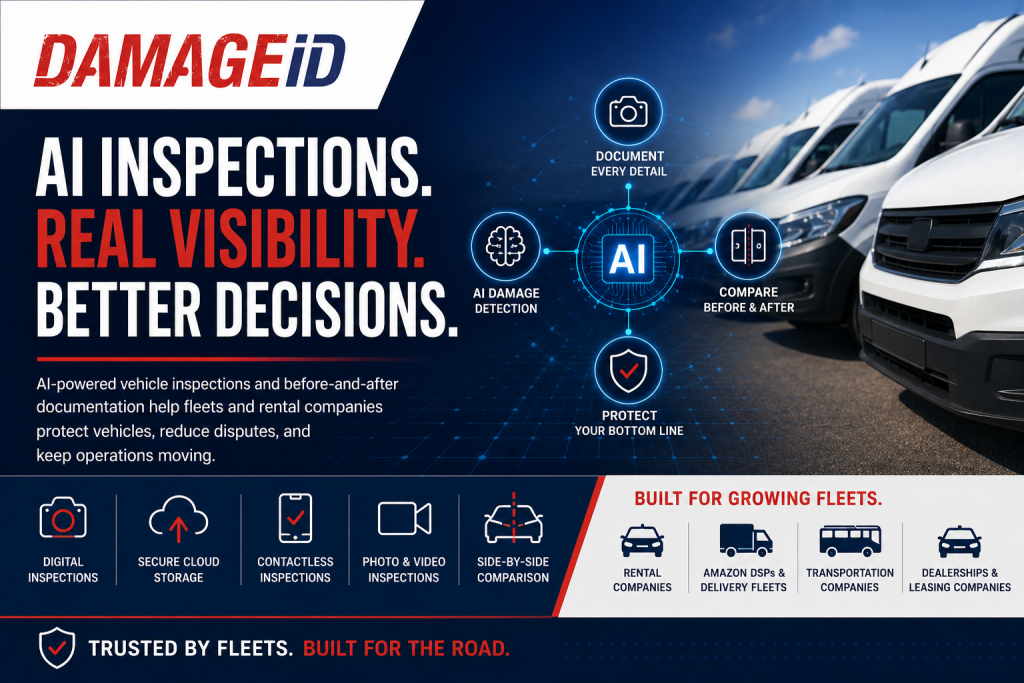
DAMAGE iD combines digital inspections with before-and-after documentation, image and video inspections, side-by-side comparisons, AI-supported damage detection, centralized inspection records, and contactless customer inspections.
For rental companies, that can mean better documentation between customers and easier access to vehicle history.
For Amazon DSPs and delivery fleets, it can mean a faster, more consistent process for vehicles that are constantly moving.
For transportation operators, it can provide greater visibility into vehicle condition and damage history.
And because implementation matters, the platform is designed around straightforward workflows that can typically be completed quickly, with minimal training.
The broader industry movement toward AI-powered inspection technology is clear. But the companies that benefit most will likely be the ones that treat AI as part of an operational process rather than as a replacement for one.
AI can help identify potential damage.
Digital documentation can help establish what changed.
Human judgment can help determine what happens next.
That combination is what makes the technology useful.
The Next Step Is Better Visibility
Vehicle inspection technology is evolving quickly, and recent market growth and industry adoption suggest that AI-assisted inspections will continue becoming more common. (TimesTech)
But the fundamental business problem has not changed.
Fleet operators need to know what condition their vehicles are in.
They need to know when that condition changed.
They need documentation they can trust.
And they need a process that employees can actually follow.
AI can help make that possible, but the technology works best when it supports a clear, consistent inspection workflow.
Is your current inspection process giving you the visibility you need, or are your employees still spending too much time documenting and investigating vehicle condition manually?