
Paper inspections have been used in fleet operations for decades.
They are familiar, simple, and easy to distribute. But as fleets grow and operations become more complex, paper processes often create limitations that slow teams down and increase risk.
Digital inspection platforms like DAMAGE iD were built to solve those challenges.
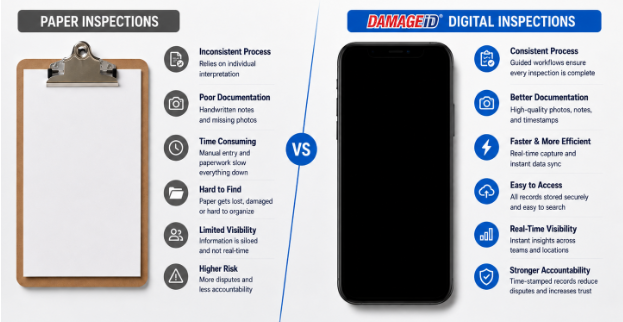
Here is a side-by-side look at how paper inspections compare to a structured digital inspection process.
1. Consistency
Paper Inspections
Paper forms depend heavily on the individual completing them.
Some inspections are thorough. Others are rushed or incomplete. Missing information is common, especially during busy periods.
DAMAGE iD
Guided workflows help standardize inspections across vehicles, teams, and locations.
Every inspection follows a consistent process with required documentation and photo capture.
2. Documentation Quality
Paper Inspections
Handwritten notes can be unclear or incomplete. Photos are often stored separately or not captured at all.
Tracking vehicle conditions over time becomes difficult.
DAMAGE iD
Digital inspections include organized photo documentation, timestamps, and centralized records that are easy to access when needed.
3. Speed and Efficiency
Paper Inspections
Paper forms require manual handling, storage, and review.
Information may need to be re-entered into other systems later, creating additional work.
DAMAGE iD
Inspection results are stored instantly and accessible in real time.
This reduces administrative work and speeds up workflows across operations.
4. Accountability
Paper Inspections
Missing forms, incomplete signatures, and inconsistent records can create uncertainty during disputes.
DAMAGE iD
Structured digital records create a clearer chain of accountability with time-stamped documentation.
5. Accessibility
Paper Inspections
Finding historical records can be time consuming, especially across multiple vehicles or locations.
DAMAGE iD
Inspection history is searchable and accessible from a centralized system, making it easier to review vehicle conditions over time.
6. Scalability
Paper Inspections
As fleets grow, paper processes become harder to manage consistently.
Storage, organization, and oversight become larger operational burdens.
DAMAGE iD
Digital workflows scale more efficiently across larger fleets and multiple locations.
7. AI Support
Paper Inspections
Paper processes rely entirely on human observation and manual review.
DAMAGE iD
AI-supported inspections help improve consistency, support damage detection, and reduce missed issues.
Why Fleets Are Moving Away From Paper
The shift is not just about going digital.
It is about improving:
- Visibility
- Speed
- Accuracy
- Accountability
- Operational efficiency
As customer expectations and operational demands increase, paper processes become harder to sustain at scale.
Final Thoughts
Paper inspections may feel familiar, but familiarity does not always mean efficiency.
Digital inspection platforms help fleets create more reliable records, streamline workflows, and reduce operational friction.
The goal is not just replacing paper. It is improving the entire inspection process.
See It in Action
DAMAGE iD helps fleets move beyond paper inspections with structured digital workflows, photo documentation, and AI-supported inspections.
Start your free trial here:
https://www.damageid.com/free-trial/